
A commercial truck rarely gets an easy day. A line-haul truck is applicable in heavy work for most of the time, and all components of the vehicle must withstand the safety load. Low and high gears transmission shaft is one of such components.
The shaft transfers the power from the input and keeps the selected gears in the required position. This absorbs all shocks that happen when the driver is changing gears.
This article looks at how better shaft engineering shows up in fuel use, durability and uptime. Using figures from U.S. government sources, starting with the 23% share of transportation emissions that trucks carry.
Why the Main Shaft Matters at Fleet Scale
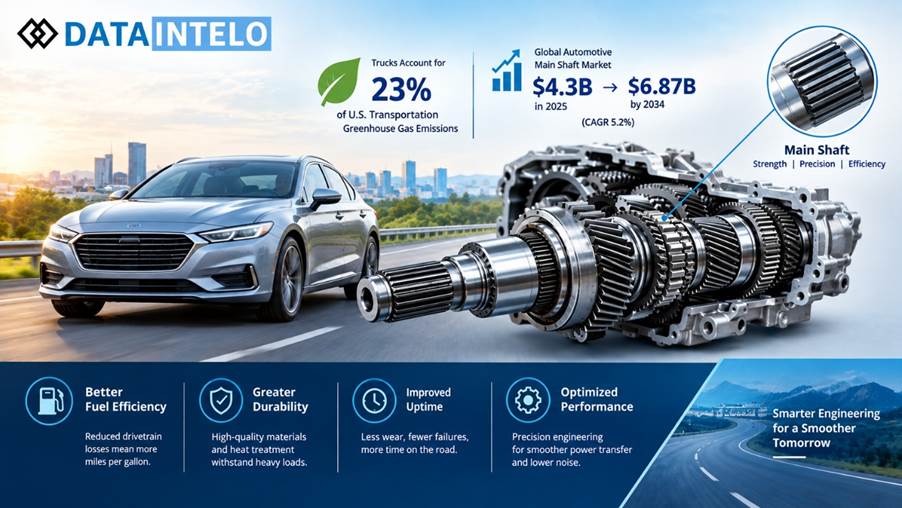
Heavy vehicles are a significant factor in the environmental burden of road transport. As reported by the U.S. Environmental Protection Agency, medium- and heavy-duty trucks were responsible for 23 percent of the greenhouse gas emissions from the transportation industry in 2022. Putting them second in the list of greenhouse gas emitters after light-duty vehicles.
Whenever one class covers almost a quarter of sector emissions, any innovations in widely used components are likely to add up.
The supply side of this issue illustrates this trend. As per Dataintelo research, the global automotive main shaft market at $4.3 billion in 2025, projecting it will reach $6.87 billion by 2034, which indicates a compound annual growth rate of 5.2 %.
Such stable growth indicates that manufacturers continue investing in the development of better materials and technologies and highly effective testing.
Where the Energy Actually Goes
The U.S. Department of Energy publishes a breakdown of energy losses for a typical combination tractor-trailer on level road [2]. The figures explain why drivetrain engineering is a game of precision rather than dramatic leaps.
| Loss type | City driving | Highway driving |
| Engine losses | 58-60% | 58-59% |
| Aerodynamic losses | 4-10% | 15-22% |
| Rolling resistance | 8-12% | 13-16% |
| Drivetrain | 5-6% | 2-4% |
Drivetrain losses, which consist of the transmission and the shafts, account for 5-6% of the energy during city driving and 2-4% during highway driving.
These losses look small relative to engine losses, which can be as high as 58-60%; nevertheless, drivetrain losses can be reduced significantly without modifying the engine and the truck’s shape.
So, if only half of the 2-4% highway losses could be eliminated, it would increase the energy efficiency of the truck by 1% to 2%.
Duty cycle is another important factor. In city driving, inertia and braking result in energy losses of 15-20%, while it is 0%-2% during highway driving [2].
Thus, due to constant starts and stops, delivery trucks experience much more load reversals than trucks driving on highways, and thus shaft specifications should be chosen according to a truck’s application rather than according to the catalog.
Engineering Changes That Reduce Losses
Several design choices work together to keep a main shaft strong, accurate and efficient:
- Composition and heat treatment: Alloy steel provides a hard exterior to resist wear and a resilient core to absorb shocks. The toughness is put to the test as approximately 15-20% of energy spent is lost to inertia and braking on short city trips.
- Exact machining: CNC grinding of the gears’ splines, and seats increases precision in force distribution providing less friction between drivetrain components.
- Treatment of the surfaces: Shot peening and polishing help slow down the development of fatigue fractures in the drivetrain systems.
- Lubrication system: Internal ducts in the gearbox help circulate the oil throughout the gears so that they operate correctly and temperatures are kept stable.
- Weight control: Hollow shafts guarantee that the machinery stays light since saved weight contributes to increased payload.
While improvements in each of the areas alone are not significant, together they allow getting a very reliable piece of machinery that will operate without failures for years to come.
Load Paths, Stiffness and Gear Contact
The main shaft will not work independently but will always be between bearings, gear sets, and synchronizers. The stiffness of all this assembly influences the load transfer through the shaft.
A shaft that bends too much under the action of torque will allow gears to become inclined, resulting in a high contact stress on its narrow strip on each tooth.
Designers solve this problem by employing bigger journal diameters, minimizing unsupported lengths, and helical gear geometry that improves load distribution among the teeth.
Improved load sharing, in turn, reduces the noise of engines, which is critical for the driving crew working at the wheel for long hours. Since drivetrain losses sit at only 2-4% on the highway, keeping tooth contact clean is one of the few ways to protect that thin margin.
Simulation, Testing and Monitoring
Shaft development in today’s world is heavily dependent on software. Finite element analysis helps engineers understand where to expect stress in splines and shoulders. The models of torsional vibrations show how the shaft works together with the engine and the whole drive line.
This means that it is possible to conduct revisions on the design before the steel is cut, which is important because budgets for development are not unlimited and all the projects are competing with each other for funding. In addition to vehicles, the use of sensors allows monitoring of the shaft operation in real-time.
Through vibration analysis and measurement of oil temperature and debris, the fleet can learn about deterioration in advance and anticipate the failure of the shaft. The impact of the losses can be considerable as 58-60% of the energy is lost in the engines.
Main Shafts in Automated and Electrified Drivetrains
Many commercial automobiles today have switched to automated manual transmissions that allow consistent torque application at the right time, unlike a fatigued human being who has been working long hours.
Hence, the consistency minimizes impact loading on the shaft as well as provides more predictable wear which is important for maintaining the performance of a drivetrain that composes only 2-4% of the total vehicle weight.
Electricity plays an important role here as well. Companies are eager to explore hybridization as well as electrification of different types of vehicles. Medium- and heavy-duty trucks produce 23% of greenhouse gas emissions generated during transportation.
Regenerative braking is a method that recovers an amount of energy lost in stop-start delivery tasks, where inertia and braking constitute 15-20% of losses; thus, shafts must withstand their reversal stresses.
Practical Points for Fleet Managers
Engineering only pays off when it meets good maintenance. A few habits help:
- Match specifications to duty cycle. City and vocational trucks, with 15-20% of energy lost to inertia and braking, need different durability margins than highway tractors.
- Keep to lubrication schedules. Clean oil of the correct grade protects a drivetrain that already operates within a 2-6% loss band.
- Listen for early warnings. New whine, vibration or difficult shifting often points to wear at splines or bearings.
- Track trends, not single readings. Gradual temperature or vibration changes say more than one-off values.
- Buy to specification. Replacement shafts should meet the original manufacturer’s material and hardness requirements.
Taken together, these habits treat the shaft as part of a system rather than a standalone part, which is how a 2-6% drivetrain loss band gets protected across a vehicle’s working life.
Automotive Main Shaft Engineering and Commercial Vehicle Efficiency
Although the primary shaft will not be the section of a commercial vehicle that people pay the most attention to, it is still crucial to the vehicle’s overall fuel consumption, reliability, and maintenance requirements.
Because trucks consume 23% of the total U.S. transport emissions and the market for the main shaft is expected to reach $6.87 billion by 2034. The further development of this component is a practical solution aimed at improving the productivity and efficiency of heavy vehicles in the future.